
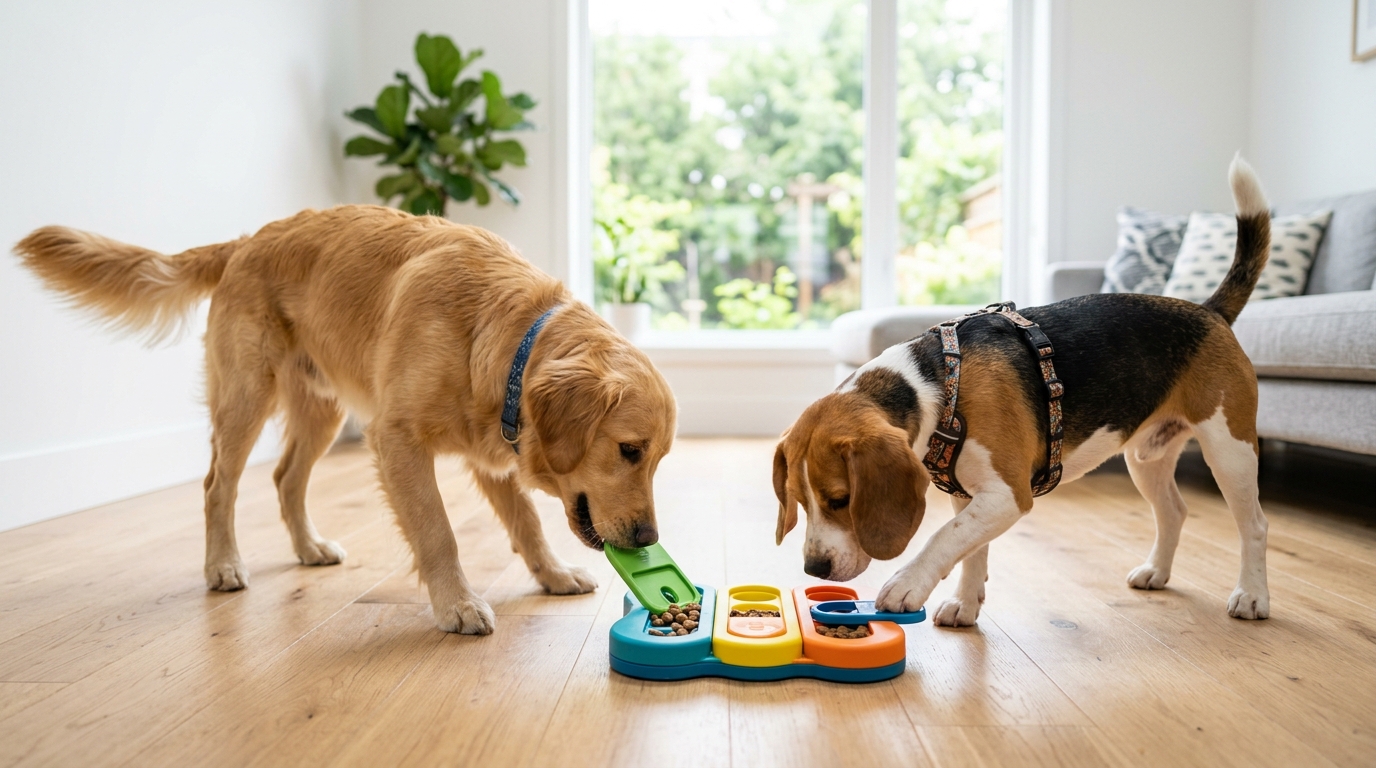
Your dog approaches their dinner bowl not with the relaxed enthusiasm of a diner, but with the ruthless speed of an industrial vacuum cleaner deployed on a hazardous spill. Four seconds flat. Zero chewing detected. A frantic metallic clattering sound as ceramic meets teeth, followed immediately by heavy panting, involuntary hiccups, and that wide-eyed, hopeful glare wondering when the actual meal is scheduled to arrive. If your dog finishes dinner before you even finish setting the scoop back into the food bin, you are not alone.
Rapid eating—medically known as food gulping—is one of the most common and unnerving canine habits. While humans view eating as a leisure activity meant to be savored with table manners, millions of years of evolutionary wiring tell your dog that unconsumed food is vulnerable food. Unfortunately, this biological instinct collides head-on with domestic biology, leading to gas, uncomfortable regurgitation, and the catastrophic risk of gastric torsion. Here is why dogs inhale their meals, the physiological hazards of the four-second cleanout, and how cognitive puzzle feeders turn dinner into a healthy, satisfying mental game.
The evolutionary code behind the canine vacuum cleaner
To understand why your golden retriever or terrier treats dinner like a timed Olympic heat, look to the pack survival instincts of their wild ancestors. In nature, when a wolf pack makes a kill, food security is strictly temporary. Scavengers lurk, weather deteriorates, and larger dominant pack members take priority. The canines that survived and passed on their genetics were those capable of unhinging their jaws, ingesting maximum protein in minimal seconds, and digesting safely in a secluded den hours later.
Your dog might sleep on an orthopedic memory foam bed and possess a dedicated toy chest, but their brainstem still operates on ancestral software. When food hits the bowl, primal survival switches trip: Consume now, ask questions never. In multi-pet households, this instinct intensifies even further, as the mere sight of another dog or cat pacing in the hallway amplifies perceived resource competition.
Why speed-eating is a veterinary hazard, not a quirky trick
While watching a dog inhale an entire bowl of kibble in the blink of an eye can look comical, the physiological aftermath is genuinely dangerous. When kibble is swallowed whole without mastication or salivary breakdown, several cascading health risks emerge:
- Choking and Tracheal Obstruction: Swallowing dry, unchewed morsels in rapid succession can cause food to catch in the pharynx, triggering terrifying coughing, gagging fits, and potential airway blockage.
- Post-Meal Regurgitation: Unlike vomiting (which involves active abdominal contractions), regurgitation is a passive ejection of undigested, unchewed kibble coated in esophageal mucus that happens minutes after a lightning-fast meal because the stomach simply cannot accommodate the sudden volume.
- Aerophagia (Air Gulping): Fast eaters swallow as much ambient air as they do food. This excess gas leads to painful abdominal distension, intestinal cramping, and foul-smelling flatulence.
- Gastric Dilatation-Volvulus (GDV / Bloat): The most fatal risk of all. When a dog gulps food and air rapidly—especially in deep-chested breeds like German Shepherds, Great Danes, Standard Poodles, and Boxers—the stomach can fill with gas and twist on its mesenteric axis. GDV cuts off blood flow to the heart and stomach wall and can turn fatal within hours without emergency surgical intervention.
Why flat bowls fail and puzzle slow feeders succeed
A standard stainless steel or ceramic dish acts as an open runway. The dog lowers their snout, shovels kibble with their tongue, and swallows by the handful. To alter the physical mechanics of eating, you must introduce cognitive friction that requires intentional snout and paw manipulation.
Interactive puzzle slow feeders achieve what human vocal reminders never could: they make fast eating physically impossible by breaking the meal into dozens of small, rewarded tasks. Instead of gulping an open mound, the dog must sniff out treats, slide tiles with their nose, rotate scent-vented discs, and dislodge hidden compartments with their paws.
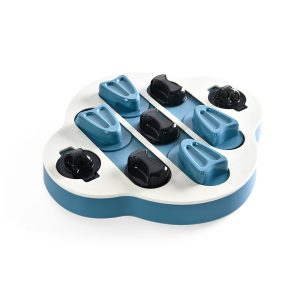
&url=https://www.tailrific.com/product/interactive-iq-puzzle-slow-feeder-senior-level-3/&media=https://www.tailrific.com/wp-content/uploads/tailrific-products/ep-de004/1.jpg)
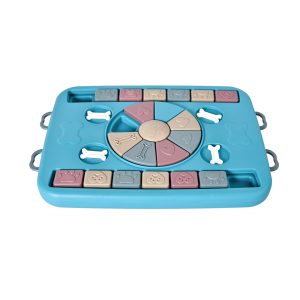
&url=https://www.tailrific.com/product/interactive-iq-puzzle-slow-feeder-intermediate-level-2/&media=https://www.tailrific.com/wp-content/uploads/tailrific-products/ep-de003/1.jpg)
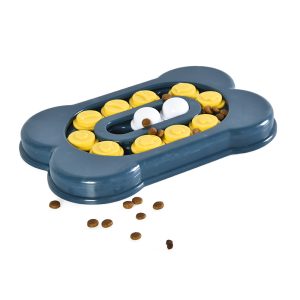
&url=https://www.tailrific.com/product/interactive-iq-puzzle-slow-feeder-junior-level-1/&media=https://www.tailrific.com/wp-content/uploads/tailrific-products/ep-de002/1.jpg)
The Tailrific Interactive IQ Puzzle Slow Feeder Series is engineered across three calibrated progressive difficulty levels to challenge your dog’s cognitive capabilities without generating mealtime frustration:
- Junior (Level 1, SKU: PLEP-DE002): The ideal starting point for puppies, small breeds, and dogs new to cognitive toys. Features smooth sliding treat compartments and rotating scent discs that slide effortlessly with a gentle nudge of the nose or paw.
- Intermediate (Level 2, SKU: PLEP-DE003): Introduces multi-step sequential actions. Dogs must slide outer obstacles before lifting or spinning inner reservoirs to access their kibble, transforming a 30-second meal into a 10-minute mental workout.
- Senior (Level 3, SKU: PLEP-DE004): Designed for hyper-intelligent breeds and seasoned canine puzzle masters. Utilizes sequential locking mechanisms and hidden treat tracks where tiles must be navigated around corners to unlock rewards.
Every Tailrific puzzle feeder is crafted from 100% food-grade, BPA/PVC-free composite material with non-skid rubber feet that keep the feeder anchored to your kitchen floor rather than skating across the tile under enthusiastic canine investigation.
How to introduce puzzle feeders without frustrating your dog
Dogs are intelligent, but they are also creatures of habit. Handing a complex Level 3 puzzle to a ravenous dog who has only ever eaten from a flat bowl is a recipe for flipped plates, scratched furniture, or whiny defeat. Follow this simple introduction protocol:
- Stage 1: Open buffet familiarization. On day one, place high-value aromatic treats in the compartments with all sliding lids completely open. Let your dog discover that the board is a source of rewards without any physical barriers.
- Stage 2: Half-covered challenges. Slide the compartment covers halfway shut so your dog can visibly see and smell the food, requiring only a tiny nudge of their nose to reveal the prize. Praise them warmly when they move the sliders.
- Stage 3: Full closure and split portions. Once your dog understands that their nose moves the tiles, close the compartments fully. You can split their normal meal: half in a standard slow-feeder maze and half in the puzzle feeder to balance satiety with enrichment.
- Stage 4: Weekly hygiene. Food puzzles collect saliva, dried kibble crumbs, and natural pet oils. Rinse the board thoroughly after each meal with warm soapy water or run it through the top rack of your dishwasher to keep it sparkling.
Mental fatigue: The hidden superpower of slow feeding
Veterinarians and canine behaviorists frequently note that fifteen minutes of intense mental stimulation tires an active dog out more effectively than a sixty-minute leash walk. Olfactory foraging activates the canine sensory cortex, stimulating dopamine release and satisfying predatory drive in a safe, constructive way.
If your dog tends to get the post-dinner “zoomies,” barks demandingly at the back door, or wanders restlessly chewing table legs after eating, their meal did not satisfy their mental appetites. Replacing a traditional dish with an interactive puzzle turns dinner into a calming meditation, sending your dog straight to their dog bed for a relaxed, contented evening nap.
When fast eating requires a veterinary checkup
In the majority of domestic dogs, speed-eating is behavioral and evolutionary. However, sudden changes in appetite or relentless, desperate hunger (polyphagia) can indicate underlying medical issues. If your dog suddenly develops an insatiable appetite accompanied by weight loss, excessive drinking, dull coat quality, or frequent diarrhea, consult your veterinarian. Conditions like internal parasites, canine diabetes mellitus, Cushing’s disease, or pancreatic enzyme insufficiency (EPI) can prevent proper nutrient absorption, leaving the dog feeling perpetually starved despite large meals.
A calmer, safer mealtime ritual
Dinner should be an enjoyable sensory highlight of your dog’s day—not a frantic race against an imaginary competitor. By slowing down the delivery of each bite, engaging their natural foraging curiosity, and protecting their digestive tract from sudden overload, you transform mealtime from a high-speed vacuum session into a peaceful, Tailrific bonding ritual.
{ “@context”: “https://schema.org”, “@type”: “FAQPage”, “mainEntity”: [ { “@type”: “Question”, “name”: “Why do dogs eat their food so fast?”, “acceptedAnswer”: { “@type”: “Answer”, “text”: “Dogs inherit a strong evolutionary pack instinct from wild ancestors where meals had to be consumed immediately before competing predators or scavengers could steal them. Even solitary domestic dogs retain this survival behavior, which can be heightened in multi-pet homes.” } }, { “@type”: “Question”, “name”: “What are the health risks of a dog eating too fast?”, “acceptedAnswer”: { “@type”: “Answer”, “text”: “Gulping food causes dogs to swallow large amounts of air, leading to painful gas, gagging, choking, and frequent regurgitation. In deep-chested breeds, rapid eating is a leading risk factor for Gastric Dilatation-Volvulus (GDV or Bloat), a life-threatening veterinary emergency.” } }, { “@type”: “Question”, “name”: “How do interactive puzzle slow feeders work?”, “acceptedAnswer”: { “@type”: “Answer”, “text”: “Puzzle slow feeders divide a dog’s meal into multiple small compartments covered by sliding tiles, rotating discs, or locking sliders. The dog must use their nose, scent, and paws to dislodge each compartment, extending meal times from 30 seconds to 10-15 minutes.” } }, { “@type”: “Question”, “name”: “Which puzzle feeder level should I start with for my puppy or dog?”, “acceptedAnswer”: { “@type”: “Answer”, “text”: “Begin with Level 1 (Junior) for puppies, small dogs, or any dog new to mental enrichment puzzles. Once your dog easily slides the simple covers without hesitation, graduate to Level 2 (Intermediate) and Level 3 (Senior) for complex multi-step locking challenges.” } }, { “@type”: “Question”, “name”: “Can puzzle slow feeders tire out a high-energy dog?”, “acceptedAnswer”: { “@type”: “Answer”, “text”: “Yes. Engaging a dog’s olfactory cortex and problem-solving abilities for 15 minutes provides as much cognitive fatigue as an hour-long physical walk, promoting calmer post-meal behavior and reducing boredom-induced destructive chewing.” } } ] }