
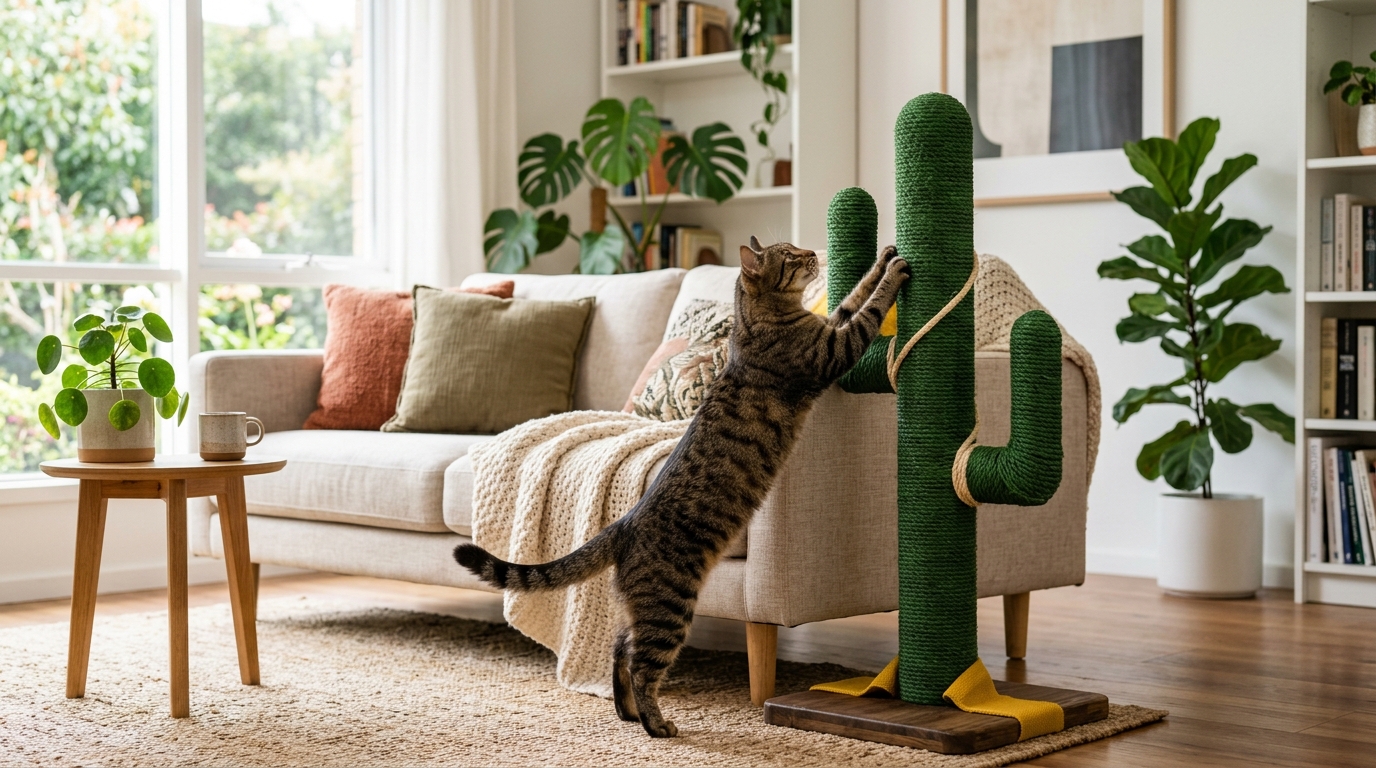
You deliberated for weeks before purchasing the sofa. You weighed fabric swatches, debated neutral undertones, verified delivery dimensions, and envisioned quiet Sunday afternoons curled up with a book. Your cat, meanwhile, took one glance at your handcrafted centerpiece and arrived at an entirely different conclusion: you had thoughtfully installed an enormous, vertically anchored, multi-thousand-dollar emery board positioned precisely at the prime territorial crossroads of the living room.
Within days, crisp upholstery corners transform into shredded fringe. Threads hang like moss, foam backing peeks through woven linen, and every time you walk into the room, your cat looks up from the crime scene with calm, unblinking satisfaction. Before you resign yourself to wrapping every piece of furniture in clear vinyl like a 1970s parlor, take comfort in feline science: your cat is not destroying your sofa out of spite, boredom, or malice. They are obeying hardwired biological imperatives. Here is why felines scratch, why standard deterrents fail, and how to redirect clawing instincts toward dedicated sisal structures that save your furniture.
The three biological drivers behind feline scratching
To end the battle between claws and cushions, you must understand what scratching actually accomplishes for your cat. In feline physiology and ethology, scratching fulfills three vital, non-negotiable functions:
- Manicure and Claw Sheath Shedding: Unlike human nails that grow continuously outward, cat claws grow in concentric layers like an onion. As new keratin forms underneath, the dull, worn outer husk must be physically stripped away. Scratching hooks the husk on coarse fibers and pops it off, exposing the needle-sharp new claw beneath.
- Chemical and Visual Territorial Marking: Cats have interdigital scent glands nestled between the paw pads. When they rake their claws downward, they deposit personal pheromones while leaving distinct, ragged visual gouges. In feline language, this double marker broadcasts: “This territory is occupied, safe, and surveyed.” Because your sofa sits in the center of family life, it represents the most prestigious territorial zone in the house.
- Full-Body Musculoskeletal Stretching: Watch your cat wake up from a nap: they walk over to a vertical surface, dig their front claws in, drop their chest, and pull backward against anchored resistance. This motion stretches the spine, strengthens forearm retractors, and limbers up the shoulder girdle after hours of curled slumber.
Why shouting, spray bottles, and declawing are off the table
When you catch your cat actively shredding the arm of your couch, the instinctual human response is to shout, clap, or reach for a spray bottle. Unfortunately, behavioral studies show that negative reinforcement consistently backfires with felines.
Cats do not possess the conceptual machinery to associate human anger with a biological grooming reflex. When you yell or squirt water, your cat learns only that you are unpredictable and scary when you enter the room. They will continue scratching the couch—they will simply wait until you go to work, step into the shower, or fall asleep. Declawing, meanwhile, is an amputation of the terminal toe bones (the distal phalanges) that causes permanent chronic pain, arthritis, litter box avoidance, and compensatory biting. Declawing is never an ethical solution.
The only sustainable strategy is positive environmental redirection: make the couch undesirable and an adjacent scratching alternative irresistibly attractive.
What makes an irresistible scratching post?
Pet supply stores are full of lightweight, felt-covered scratching posts that collect dust because cats refuse to touch them. A functional scratching post must satisfy three physical criteria:
- Rock-Solid Heavy Base: A cat weighs between 8 and 15 pounds and applies significant horizontal torque when stretching. If a post tips, slides, or wobbles, it frightens the cat. The couch never wobbles—so your alternative cannot wobble either.
- Proper Texture: Fabric and carpeting confuse cats because they feel identical to your rug and upholstery. Pure, untreated natural sisal rope provides optimal claw resistance, satisfying tactile crunch, and durable shredded texture without fraying into hazardous synthetic strands.
- Adequate Height: Cats want to stretch their bodies to their full length. If a post is only 18 inches tall, an adult cat must hunch over awkwardly, which feels unnatural and uncomfortable.
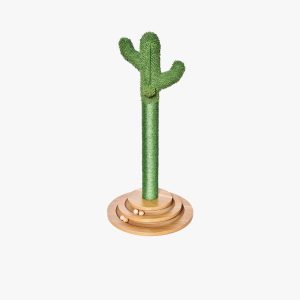
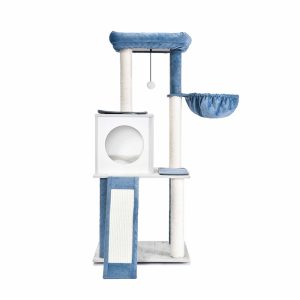


Tailrific offers two engineered solutions designed to satisfy feline stretching and climbing instincts while complementing your modern home interior:
- 2-in-1 Cactus Cat Scratching Post with Ball Track Toy (SKU: PL13PF0329): Crafted with a thick, weighted solid-wood base that stays firmly planted during energetic clawing. Wrapped in tightly bound, vibrant green natural sisal with multi-directional cactus arms that allow both vertical reaching and lateral paw swiping. The built-in interactive wooden ball track at the base redirects playful hunting energy into constructive claw exercise.
- 45-Inch Multi-Level Cat Tree with Scratching Board & Hammock (SKU: PL13PF0320): For cats that crave both vertical territory and high-elevation surveillance. Features multiple sisal-wrapped structural columns, an angled lower scratching ramp for horizontal scratchers, a plush deep-dish hammock, and an elevated observation perch that lets your feline survey the entire room from safety.
The 4-step peace negotiation protocol
Setting a brand-new scratching post in the corner and expecting your cat to instantly forget their beloved couch will lead to disappointment. Follow this proven 4-step behavioral transition:
- Step 1: Secure the Crime Scene. Cover the specific corners of your couch where scratching has occurred with temporary double-sided pet training tape or a smooth, tightly tucked microfiber throw blanket. Cats despise sticky or slick textures that prevent their claws from catching and anchoring.
- Step 2: Position the Alternative at Point Zero. Do not place the new scratching post across the room or behind an armchair. Place the Tailrific Cactus Scratcher or Cat Tree directly in front of the taped couch corner, practically touching the furniture.
- Step 3: Prime with Organic Catnip and Play. Rub fresh organic catnip or silvervine powder into the sisal fibers. Dangle a feather wand near the post so that during play, your cat’s claws naturally strike and catch the sisal. When they realize how deeply their claws can sink into the coarse rope without getting yelled at, they will immediately experience tactile satisfaction.
- Step 4: Praise and Reward. Whenever your cat approaches the sisal post and executes a vertical stretch, offer a high-value treat and verbal praise. After two weeks of consistent post usage, you can safely remove the protective tape from your couch and slowly migrate the post a few inches per day toward your preferred corner.
Horizontal vs. vertical scratchers: What is your cat’s style?
While most cats prefer vertical stretching on sofa corners and upright posts, some felines are dedicated horizontal scratchers who target wool rugs, stairs, and bathmats. If your cat habitually scratches flat surfaces with their rear legs planted on the floor, an upright pole alone may not solve the issue. Look for modular structures—such as the integrated scratching ramp on the Tailrific 45-Inch Multi-Level Cat Tree—that provide both a 45-degree angled incline and sturdy horizontal scratching planes.
Restoring living room harmony
Your furniture and your cat do not have to be natural enemies. By recognizing that scratching is a healthy, instinctual expression of feline vitality and providing robust, attractive, and properly placed alternatives, you protect your home decor while giving your cat the rich sensory enrichment they deserve.
{ “@context”: “https://schema.org”, “@type”: “FAQPage”, “mainEntity”: [ { “@type”: “Question”, “name”: “Why do cats scratch furniture instead of their scratching post?”, “acceptedAnswer”: { “@type”: “Answer”, “text”: “Cats prefer furniture when their designated scratching posts are too short, wobbly, or placed in remote locations. Couches are heavy, stable, located in central social areas, and covered in textured fabric that provides excellent claw resistance.” } }, { “@type”: “Question”, “name”: “Does yelling or using a spray bottle stop a cat from scratching the couch?”, “acceptedAnswer”: { “@type”: “Answer”, “text”: “No. Negative reinforcement like shouting or spraying water causes stress and fear without curbing the biological instinct to scratch. The cat simply learns to avoid humans and scratch the furniture when you leave the room.” } }, { “@type”: “Question”, “name”: “How tall should a cat scratching post be?”, “acceptedAnswer”: { “@type”: “Answer”, “text”: “A vertical scratching post should be at least 28 to 32 inches tall. This allows an adult cat to fully stretch their spine and shoulder muscles upward while hooking their claws into the material.” } }, { “@type”: “Question”, “name”: “What is the best material for a durable cat scratching post?”, “acceptedAnswer”: { “@type”: “Answer”, “text”: “Natural sisal rope is the gold standard. It offers tough resistance, shreds satisfyingly under feline claws without fraying into synthetic hazards, and does not confuse the cat with carpeting textures.” } }, { “@type”: “Question”, “name”: “How do I redirect my cat from my sofa to a new scratching post?”, “acceptedAnswer”: { “@type”: “Answer”, “text”: “Cover damaged sofa corners with double-sided pet tape to deter claws, place the new heavy-base sisal post directly next to the couch, rub the post with catnip, and immediately reward your cat with treats whenever they scratch the post.” } } ] }