
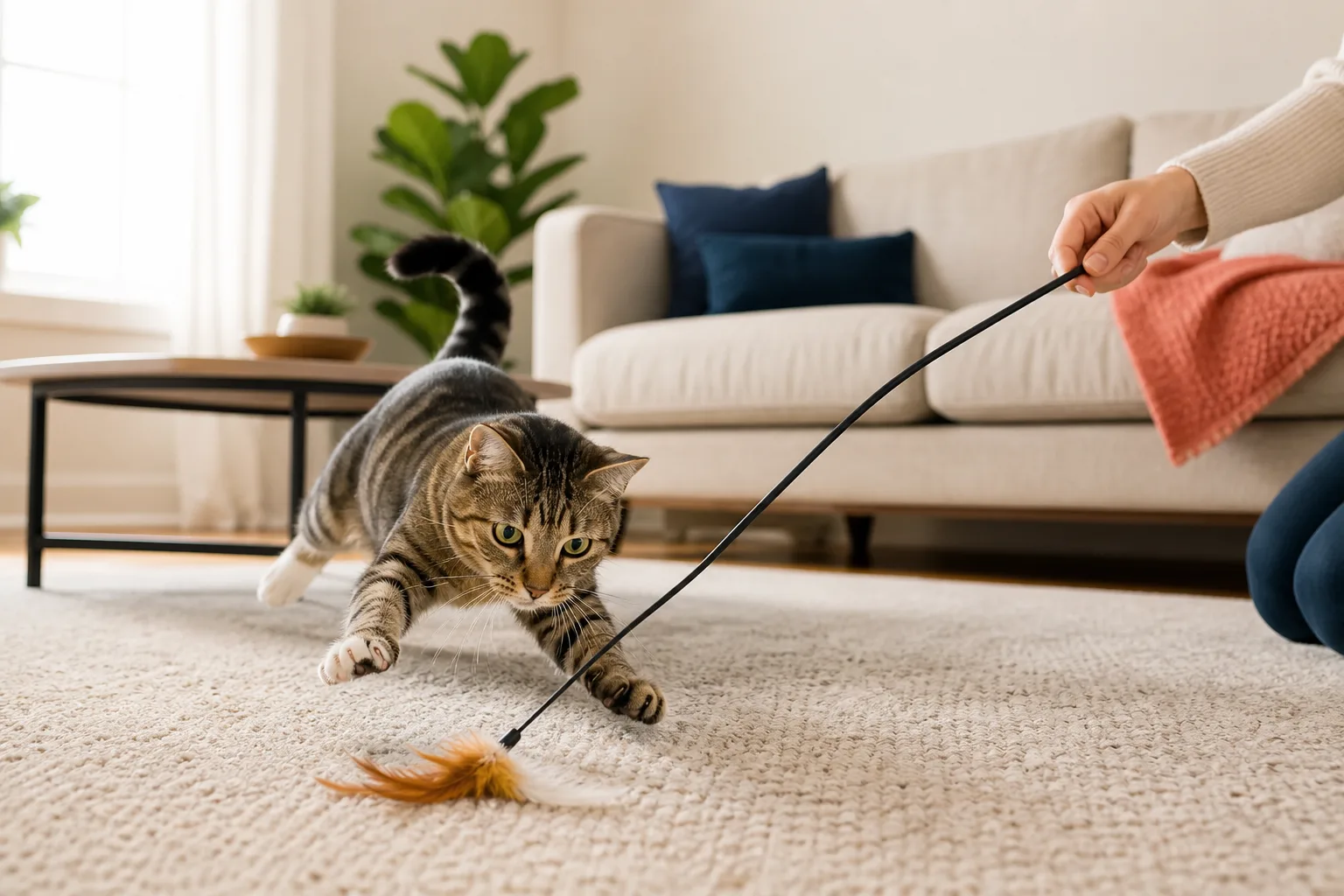
If your indoor cat is staring at your ankles like they have entered the prey category, the entertainment committee may be underfunded. Cats can amuse themselves with a receipt, one beam of sunlight, or the box from the toy you actually bought—but spontaneous chaos is not the same as a satisfying play routine.
Interactive play gives your cat a safe way to stalk, chase, pounce, and capture while giving you a front-row seat to the world’s smallest wildlife documentary. The secret is not nonstop motion. It is moving the toy like prey, letting your cat win, and ending before anyone becomes frustrated.
Your cat needs a hobby besides evaluating your life choices
Play can provide movement, mental engagement, and an outlet for predatory behavior—especially for indoor cats whose scenery changes less often. But cats are individuals. A young cat may launch into the air like a furry popcorn kernel; a senior may prefer one strategic paw from a premium pillow. Both can be successful play.
A sudden loss of interest in play, hiding, unusual fatigue, pain, or another meaningful behavior change deserves veterinary attention. Do not automatically diagnose boredom when your cat may be telling you something important.
Think mouse, not malfunctioning ceiling fan
Drag the attachment along the floor. Let it disappear behind a chair. Pause. Peek out. Make one short escape and stop again. Constantly waving a toy in your cat’s face is less “thrilling hunt” and more “unexpected presentation at a business meeting.” The silent stare is often planning, not disinterest.
- Start subtle. Give your cat time to notice and choose to engage.
- Vary the speed. Mix quick escapes with slow, ground-level motion.
- Build in victories. Allow regular catches and a final capture.
- Read the room. Stop for hiding, growling, flattened ears, hard tail lashing, or redirected biting.
Choose a toy—not an unsupervised feather buffet
Wand toys put helpful distance between fingers and enthusiastic claws. Before every session, inspect feathers, strings, connectors, and small parts. Retire anything loose or damaged. These toys are for supervised interactive play and should be stored where your cat cannot chew, tangle in, or swallow pieces while you are away.
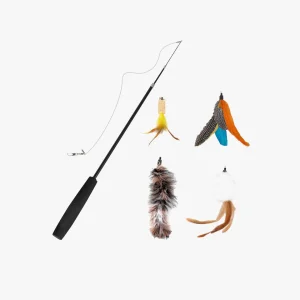

The Tailrific Cat Wand Toy includes four feather attachments and an interchangeable eye-hook connector. Use one attachment at a time, secure it before play, inspect it afterward, and store every piece out of reach. Variety makes the hunt interesting; supervision keeps the setup sensible.
Give the tiny hunter a proper finale
Start quietly, build toward a few chases or pounces, then slow the movement. Let your cat make a final capture instead of ending with the prey mysteriously vanishing into a closet. Some cats settle nicely when play is followed by part of their normal meal, provided you account for daily nutrition and any veterinary diet instructions.
Know when the whiskered director has yelled “cut”
Loose movement, stalking, forward interest, and voluntary re-engagement usually mean the game is welcome. Flattened ears, growling, repeated tail lashing, skin twitching, hiding, or biting redirected toward you can signal frustration or overstimulation. Pause and give your cat space. Also, never use hands or feet as prey unless you want to schedule surprise ankle meetings at 2 a.m.
Build a home, not one enormous nap station
Rotate toys, add scratching surfaces, provide hiding spots and safe elevated areas, and offer window views when appropriate. Multi-cat homes may need separate sessions so the cautious cat is not repeatedly outbid by the confident one. The goal is not to manufacture a feline athlete; it is to create regular, positive opportunities to do cat things.
Success is whatever the cat says it is
Three careful stalks count. One glorious pounce counts. A senior cat reaching from bed absolutely counts. Move the toy thoughtfully, allow captures, supervise every session, and stop while the experience is still positive. Less pressure. Fewer ankle ambushes. More Tailrific moments.