
Indoor cats can turn almost anything into entertainment: a paper bag, a patch of sunlight, or the important receipt you planned to keep. Still, spontaneous mischief is not the same as a dependable play routine. Interactive play gives a cat an appropriate way to stalk, chase, pounce, and capture while also creating a predictable moment of connection with you. The routine does not need to be elaborate; it needs to fit the cat in front of you.
Your cat needs a hobby besides judging you
Play can provide physical activity, mental engagement, and an outlet for natural predatory behavior. It may be especially valuable for indoor cats whose environment changes very little from day to day. However, cats vary widely. Age, mobility, confidence, previous experience, and health all affect how a cat prefers to play. A young cat may sprint after a toy, while an older cat may be happiest tracking slow movement from a comfortable position.
If your cat suddenly stops playing, hides more than usual, seems painful, becomes unusually tired, or shows another meaningful behavior change, contact your veterinarian. A new lack of interest should not automatically be labeled boredom. Once health concerns are addressed, you can adjust the environment and play style without pressuring the cat to perform.
Think like prey, not like a ceiling fan
Wand toys are most engaging when the attachment moves like something a cat might naturally notice. Slide it along the floor, pause behind furniture, let it peek around a corner, or make short movements followed by stillness. Constantly waving the toy directly in the cat’s face can be confusing or overwhelming. Give your cat time to watch and plan. The silent stare is not a failed session; it is often part of the hunt.
- Start small. A few focused minutes may be more successful than one long session.
- Use varied movement. Alternate quick escapes with pauses and slower ground-level motion.
- Allow a capture. Let your cat catch the attachment regularly so the game has a satisfying outcome.
- Follow the cat’s limits. Stop if your cat walks away, becomes overstimulated, or shows defensive body language.
Choose a toy, not an unsupervised feather buffet
A useful wand toy creates distance between your hands and the moving attachment, making it easier to guide the play while reducing accidental scratches. Interchangeable attachments can add variety, but every connector, feather, string, and small component should be checked before use. Retire damaged pieces immediately. Wand toys and feather attachments are for supervised interactive play, not for leaving in a room where a cat can chew or swallow parts unattended.

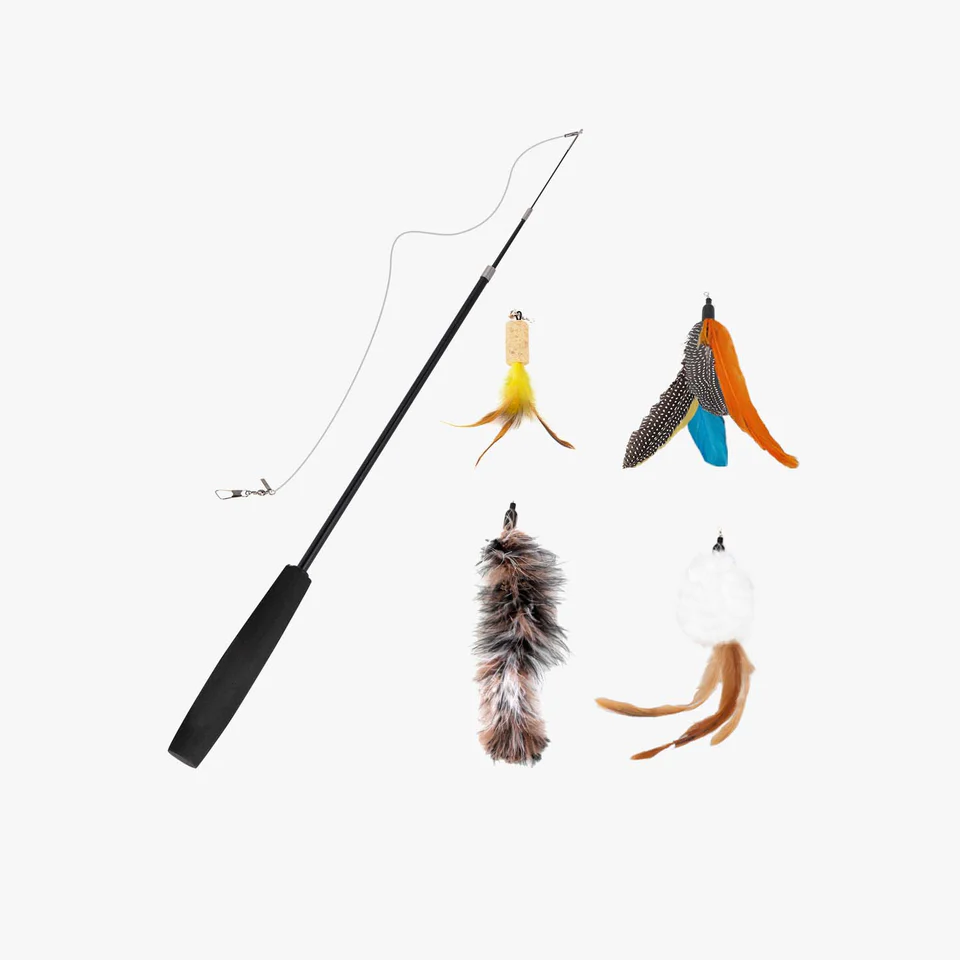
The Tailrific Cat Wand Toy includes four feather attachments and an interchangeable eye-hook connector. Use one attachment at a time, confirm that it is secured before play, and inspect it after every session. Store the wand and all attachments out of reach when playtime ends. The extra attachments provide options for variety, but supervision and routine inspection are what make the setup practical.
Give the tiny hunter a proper finale
Begin with subtle movement that attracts attention. Build toward a few short chases or pounces, then gradually slow the toy. Let your cat make a final capture before ending. Some cats settle well after a small meal or part of their normal food following play, but keep total daily nutrition and any veterinary diet instructions in mind. The goal is a calm transition, not an extra serving every time the feather makes an appearance.
Multiple brief sessions can be easier to fit into daily life than one long session. Try linking play to an existing routine, such as before breakfast or in the evening. Consistency helps you notice what your cat prefers. Track the movements, locations, and times that produce relaxed engagement, then rotate options before the routine becomes stale.
Read the room—even when the room has whiskers
Loose movement, forward interest, stalking, and voluntary re-engagement generally suggest the activity is welcome. Flattened ears, growling, repeated tail lashing, skin twitching, hiding, or redirected biting can indicate frustration or overstimulation. Pause the toy and give your cat space. Never use your hands or feet as prey, because that teaches a pattern that is much less charming when repeated at 2 a.m.
Your home is more than one enormous nap station
Interactive play works best as one part of a broader indoor environment. Provide comfortable resting places, scratching surfaces, hiding options, safe elevated spaces, and opportunities to look outside when appropriate. Rotate toys instead of leaving every item available all the time. Food puzzles may suit some cats, but introduce them gradually and account for the food used. Multi-cat households may need separate sessions so a cautious cat is not crowded out by a more confident companion.
Success is whatever the cat says it is
A successful session does not have to end with acrobatics. It may be three careful stalks, one well-timed pounce, or a senior cat reaching from a favorite bed. Offer an appropriate setup, move the toy thoughtfully, allow captures, supervise every moment, and stop while the interaction is still positive. That approach respects your cat’s needs and makes play easier to repeat—less pressure for you, more satisfying moments for your cat.